



I have an alarm on the CI60 control panel – what does it mean?
The CI60 control panel uses indicator lights to signal different types of faults. A steady red triangle may indicate a problem with the rotor in the unit. Common causes include a loose or broken belt, worn brush strips, or moisture or ice inside the unit. The rotor and belt should be checked as part of annual maintenance, and further instructions can be found in the user manual for your unit, such as UNI2, UNI3, UNI4, K2, K2.1 or C2. If the panel shows a steady red triangle together with a flashing MIN indicator, this may indicate a faulty temperature sensor in the unit. In such cases, we recommend contacting the builder, service company or retailer for further troubleshooting and possible replacement.
I have a heated garage used as a hobby workshop – how should the ventilation be designed?
The standard ventilation solution for a heated garage used as a hobby workshop is a mechanical exhaust fan combined with a supply air vent in the wall on the opposite side. This provides simple and effective air exchange. Depending on how the garage is used, for example frequent occupancy, dusty work, or a need for better temperature control, it may also be appropriate to consider a room ventilator or a balanced ventilation system. The choice of solution should be based on the extent of use, comfort requirements, and the types of activities carried out in the garage.
I have an older two-storey house and want to install balanced ventilation. Is this practically possible?
Yes, it is practically possible to install balanced ventilation in an older two-storey house, but the level of complexity will vary. On floors with an attic above, it is usually relatively straightforward to route ventilation ducts. On floors without an attic above, installation is more challenging, and ducts must typically be routed within the floor structure or boxed in along walls or ceilings. The solution must be adapted to the building’s construction and floor plan and should be carefully considered during the planning stage to ensure a good and functional result.
I have moved into a new apartment and there is a lot of noise from the diffusers – what should I do?
If there is a lot of noise from the diffusers in a new apartment, it is likely that the ventilation system has not been properly balanced. Ask the company that installed or supplied the system to check and, if necessary, adjust the balancing. Correct balancing is essential to ensure proper airflow, low noise levels, and good comfort in the home.
I want supply and extract air valves other than those in your product range. Can I use other types?
Yes, you can use supply and extract air valves other than those included in Flexit’s product range. However, please note that our design drawings and settings are adapted to Flexit valves. If other valves are used, the airflow rates must be measured and the ventilation system must be rebalanced on site to ensure correct operation and proper air distribution.
I want cooler supply air in the bedroom than in the living room. Is this possible?
Yes, it is technically possible to achieve cooler supply air in the bedroom than in the living room by installing a cooling coil on the supply air ducts. However, this is often a costly solution. In most cases, it is more cost-effective to invest in other measures, such as external solar shading, improved window shading, or reducing heat gains in the room. Cooling via the ventilation system should generally be considered a supplement to such measures, rather than a primary solution for room cooling.
I experience dust around the vents – what is the cause?
Dust around vents is a well-known and common phenomenon referred to in technical terms as dust induction. The dust deposits originate from the dust present in the room air, not from the supply air delivered by the ventilation system. When the supply air meets the indoor air, differences in air velocity and temperature can cause dust particles in the room air to become statically charged. This makes the dust more likely to adhere to surfaces near the vent.The extent of dust induction is influenced by factors such as temperature differences between the supply air and ceilings or walls, as well as the amount of dust in the indoor air. Conditions such as tobacco smoke, the use of candles, and generally high dust levels indoors can intensify the problem. Smaller temperature differences and reduced dust levels in the indoor air can help reduce dust deposits to some extent.
I am installing ducts in the attic. Do they need to be insulated with a sleeve?
Yes, ducts located in cold zones must be insulated. This can be done either by using insulation sleeves or by covering the ducts with a minimum of 100 mm of blown insulation. If the space where the ducts are installed maintains a constant temperature above 15°C, it is normally not necessary to insulate supply and extract air ducts. However, outdoor air intake and exhaust air ducts must always be insulated along their entire length, regardless of temperature conditions, to prevent condensation and heat loss.
I need a filter for my unit, but I’m not sure which model I have. How do I find out which unit I have?
You can find the model designation on a label inside the unit. Open the front cover and look for an identification label, usually located on the inside, often on one of the side panels. The label shows the model name and serial number, for example Flexit UNI 4 or EcoNordic WH4. Once you have the model name, you can easily find the correct filter at flexit.no/filter.
I need ventilation in a studio apartment. Which unit is recommended?
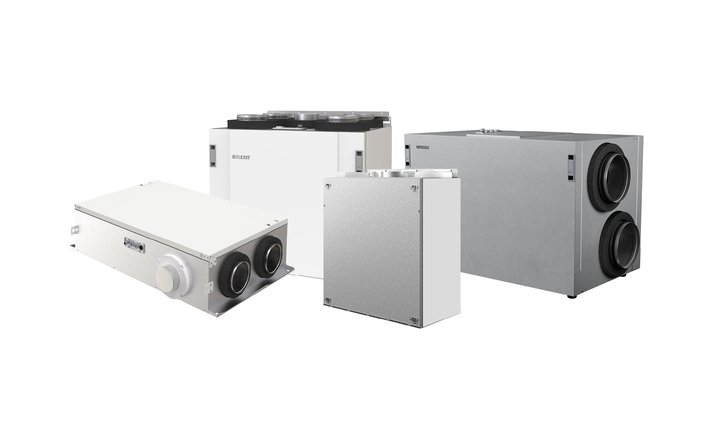
For studio apartments, Flexit often recommends kitchen ventilation units. These are balanced ventilation units designed to be installed in the kitchen cabinet above the cooker and include integrated kitchen extract. This solution provides both effective ventilation of the apartment and kitchen extraction in one single unit and is particularly well suited where space is limited.